Showing posts with label Marketing. Show all posts

Sunday, January 24, 2016

How does Twitter keep missing this obvious opportunity to increase revenue?

I don't get it.

Twitter's stock has suffered from a cascading series of meltdowns since its IPO (see chart, below) as its revenue, growth in users, and related metrics have disappointed when compared to peers like Facebook and Google.

One financial analyst, on record as a Twitter short, describes it this way:
After this week's relief rally, Twitter closed at $17.82, almost 50% down from my initial short recommendation in July 2015. In part, I believe this is because I was fundamentally right about Twitter as a niche product for a select group of power-users such as journalists, media personalities and self-important adolescents...
What I haven't grasped for years, when I first wrote about this topic in 2014, is why Twitter ignores monetizing its incredible reach through embedded Tweets:

Sunday, August 30, 2015

The last thing you see before you die

Marketing. It's both art and science, and someone just blew away all of the formulas with a single, earth-shattering invention:


I call dibs on employing this prop as the central theme of a Chuckie-style horror movie.

Hat tip: BadBlue News.
 

Sunday, April 05, 2015

EVIL CLOWN: Taco Bell Launches Cold War Against McDonald's With Soviet-Style Propaganda Imagery

Pretty funny.

Egg McMuffins aren't just mediocre pastries stuffed with microwaved eggs, bright yellow cheese and ham product. They are a form of tyranny.

That, at least, is the upshot of "Routine Republic," a riveting and surreal new Taco Bell campaign from Deutsch. A year after the agency cheekily hired a bunch of guys named Ronald McDonald to celebrate the Mexican-themed fast-food chain's first foray into breakfast, the shots at the Golden Arches are barely masked.

In the three-minute centerpiece ad ..., McDonald's affable but intrinsically creepy mascot is reimagined as a sunken-eyed Stalinist clown (though perhaps bearing closer resemblance to Mao). He rules over a small army of look-alikes and an oppressed proletariat in a decrepit, cloistered city with a beefy security apparatus. Run-of-the-mill breakfast sandwiches are his preferred method of subjugation.

Watch the video after the break:

Friday, July 18, 2014

How Twitter Can REALLY Monetize Its Reach

There was an interesting article in yesterday's WSJ concerning investors' concerns about Twitter as a growth stock.

After a troubling start as a public company, Twitter ... plans to try out some new numbers on Wall Street... When it reports second-quarter earnings on July 29, the San Francisco company is expected to unveil as many as four new metrics that it hopes will illustrate its reach beyond the 255 million users that log in at least once a month, according to people familiar with the matter. The aim: to show Twitter isn't just a diminutive Facebook Inc.


Despite doubling revenue for each of the past five quarters, Twitter's moneymaking successes have been overshadowed by faltering user growth, forcing investors to recalibrate their long-term expectations.

Twitter sizes up its digital town square by the number of users who log into the service at least once a month. That standard industry metric, called monthly active users, and a self-invented measurement called timeline views designed for advertisers to track usage, were the primary nonfinancial metrics offered to potential investors when Twitter went public in November.

But those metrics backfired after the company reported abruptly slowing user growth and signs of a less-engaged audience, sending the stock to new lows and raising unflattering comparisons to Facebook...

I personally don't think stats like monthly active users or timeline views are at all relevant for Twitter.

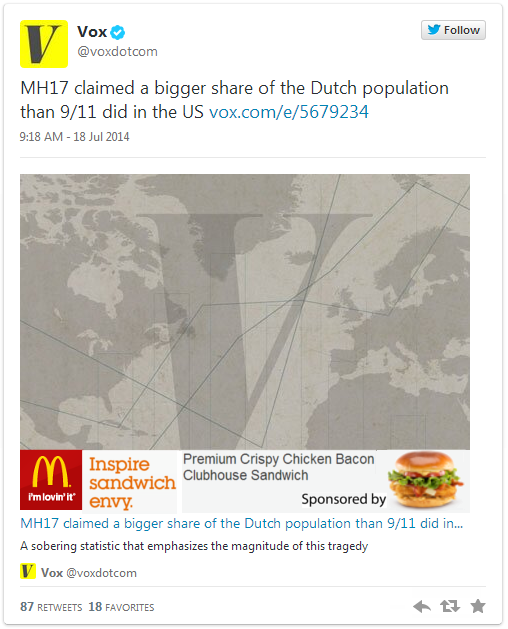
Think about it: the Twitter platform receives significantly more exposure than Facebook on new media sites like Twitchy and BuzzFeed. These sites embed tweets -- served up by Twitter -- as a key part of unfolding news stories, quite unlike any other social site:


Twitter doesn't appear to be making a cent from serving up content to news sites. The hope with embedded tweets, I suppose, is to convince people that they're missing out if they're not on Twitter. Which they are, of course.

But that said, these embedded tweets are a huge missed opportunity. Consider this hypothetical monetization approach:


Did someone say bacon?

Or perhaps a tweet with "media" (an image):


You may hate ads, but if they're targeted and relatively unobtrusive, the fact is that someone has to pay for your troubling addiction to real-time news. Natch.

Oh, and Twitter: my royalty for this idea is a paltry one percent of gross revenues, in perpetuity.


Hat tip: BadBlue Tech News.

Sunday, June 22, 2014

Marketing Genius

If you're not following @DirectorBlue, you probably missed this:


Tuesday, February 04, 2014

Bank turns a robbery into a marketing campaign. And it's fantastic!

Who says your typical banker doesn't have a good sense of humor?

A bandit made off with $26,000 of Idaho First’s money following a shootout with cops. A week later, the bank ran one of the funnier ads you’ll see from a financial institution.

January 10 was typically cold in McCall, Idaho, a small resort town with nary 3,000 residents. With temperatures lingering just below freezing, Nathan Davenport decided to hit the ATM ... outside Idaho First Bank. Wearing dark clothes and a mask, he proceeded to cut the bolts off the ATM’s door, then attached a chain to it and ripped the door free with his truck (a stolen truck, of course). Apparently this wasn’t Davenport’s first time hijacking an ATM. The caper took less than seven minutes, and Davenport split with cash totaling $26,120...

Friday, November 08, 2013

F-f-f-f-f-f-f-f-f-f-failllllll

Visiting Ace earlier tonight, I happened to click on this MetLife ad.


Here's what I got in return:


Is it really that hard to run an ad network?

Oh.

Sorry about that, Healthcare.gov. Nothing personal, y'know.


Monday, February 04, 2013

And the winner of the Superbowl was... Twitter!

Data assembled by the Altimeter Group indicates that Twitter was the dominant branding mechanism during the Superbowl, blasting Facebook in terms of volume.

Overall, we saw brands still hold onto corporate websites, although a big jump in hashtag usage, and decline in Facebook integration...

75% of Brands integrate second screen experience, up 7%. Overall, 75% of brand ads integrated social, mobile, hashtags, or apps in their $4m, 30 second spot (that’s $133k per second), this is up from 68% integration in 2012. This second screen promotion extends engagement to their websites and social sites, fostering a further integrated experience. Of note, Oreo was able to quickly create ads on social channels that tapped into the unexpected blackout, showing their advertising and marketing prowess, cross-screen. Expect this growth rate to only continue in 2014, as ads should cross the 80-90% integration rate.

Hashtags, presumably aimed for Twitter, dominate over Facebook. Hashtag integration in ads dominated the airtime, with 38% of ads including Hashtags in visual display on ads, up 31% out of a total of 64 ads. Twitter, a media-centric, network serves better for real time interactions of live events, rather than Facebook, which may spur deeper engagement through interactive media, social interactions, and applications...

And if you're not following me on Twitter, you're missing out on a veritable avalanche of borderline useful information.


Hat tip: BadBlue Tech News.

Friday, January 04, 2013

COOLEST. TAXI. EVER.

Granted, it's a promotional stunt, but still...

For an advertisement by New York-based fashion brand Nooka, designer Mike Lubrano imagined converting a DeLorean into an iconic New York City yellow taxi cab. He says that the automobiles have ‘come to symbolize the future’ and communicate the brand’s ‘futuristic philosophy.’

Yeah, yeah, yeah, whatever.

I still wanna ride in it.


Hat tip: BadBlue Car News.

Monday, October 29, 2012

GENIUS: Pepsi's Obama-style Branding Helped Crush Its Market Share

Who could have predicted that attaching your brand to an inexperienced, Alinsky-trained community organizer would turn out badly?

When Diet Coke surpassed Pepsi to become the No.2 soda in America, it was as if the Cola Wars had finally declared a winner: Coca-Cola...

[Much of the blame] has to do with the astronomical number of gaffes Pepsi has made in the past few years, particularly in its brand management and the way it has branded its flagship product...

Pepsi's 2009 logo redesign was dogged by political distractions


Pepsi paid Arnell Group an outrageous $1 million for this logo, which isn't drastically different from its predecessor.

The logo also made headlines for resembling that of newly elected President Obama...

...Coupled with Pepsi's new slogans -- "Yes You Can" and "Choose Change" -- the company was criticized for copying Obama's award-winning campaign and aligning itself with it at the same time.

Pepsi CEO Indra Nooyi, in the job for about five years, was reportedly a huge Obama backer and behind the re-branding decision. Brilliant strategy: piss off half the country with your brand. I'd rather drink tap water than a Pepsi.


Sunday, April 01, 2012

BlackBerry Maker RIM Announces New Device That People Will Actually Buy

Eh, it is April Fool's Day, after all.

...RIM said sales of BlackBerrys fell sharply in the latest quarter, leading to the company's first revenue decline in seven years. Its subscriber growth rate from the previous quarter also hit an all-time low of 3%. And two of RIM's top officers stepped down, leaving RIM's executive bench as shallow as it has ever been.

Meanwhile, morale has flagged amid the unrest, according to executives inside and outside the company.

At a dinner meeting in February between RIM's chief technology officer, David Yach, one of the executives who left Thursday, and chief information officers from companies and government agencies, including the Department of Defense, the mood from the RIM side was somber, according to a person who attended the dinner.

...The company's market capitalization hovers over $7 billion, a big bite for any buyer to swallow. Some bankers said there would be few buyers at that price tag for the whole company.

The exception would be giants like Microsoft Corp. andNokia Corp. The two explored a joint bid for RIM last year, according to people familiar with the situation, but those talks were preliminary and didn't lead to a bid.

Nokia has adopted Microsoft's operating system for its latest smart phones. Given that close partnership, the two could make a coordinated approach, if they decided to bid, according to people familiar with the situation.

If they jointly bid, the two companies would likely scrap RIM's mobile operating system and instead equip BlackBerrys with Microsoft's Windows software, with Microsoft taking over RIM's enterprise network, these people said.

RIM was on top of the world just three short years ago. Now they're gasping for air.

Most tragically, they failed to leverage their primary assets -- a secure, global network and the BlackBerry Enterprise Server (BES) software that manages corporate connectivity -- and instead tried to concentrate on the fast-moving device market. This task was made decidedly more difficult by the entrance of Google's Android operating system, which is distributed free to device makers and supports incredible diversity for handsets.

If RIM had concentrated on building highly secure client software packages for iPhones and Androids using its BES management console to control all of these devices, it would have a huge revenue stream that could have funded its device and OS operations. Instead, it failed to leverage BES on other devices, and thereby created a market for secure clients from companies like Good Technologies and MobileIron.

As it stands today, I don't see how RIM survives as a device maker.


Sunday, March 18, 2012

A brief, illustrated missive on those Can-Am Spyder Ads

If you've been watching the NCAA Tournament, even for just a few minutes, you've no doubt seen the ads for the Can-Am Spyder. This is the three-wheeled (don't call it a tricycle!) version of the venerable sportbike, presumably built for the suburbanite with an attitude. Thought not quite enough attitude to ride a real sportbike.

But the funniest part of the ads is the fawning reassurance factor, apparently revealed by careful focus-group testing. That is, the secret fear of every Can-Am buyer is: "Will Real Bikers™ Laugh At Me"?

The first attempt to assuage these concerns in the ads is this drive-by acknowledgement by real bikers. Like, don't worry, dude -- you're still cool even though you're driving a trike.

Just to reinforce the notion that Can Am drivers aren't nerds is this scene, like something out of Roadhouse. This is where the hard-assed, grizzled biker inspects the Can Am and then nods approvingly. When, as we all know, he'd be laughing his ass off, pointing, and slapping his knee.

Methinks the marketers overdid the message. Be happy in your geekiness. Revel in it. Don't fight it. Hey, it works for me!


Sunday, August 07, 2011

Heh: new Obama banner ads omit wildly unpopular president's face, use cute blonde instead

The results of the focus-group testing must have been fairly disturbing for the Obama campaign to omit an image of the President's handsome visage.

At the rate his support among the young is deteriorating, it won't be long before we see ads featuring bikini-clad Swedish girls beckoning young males to support President Subprime McTrainingwheels' campaign.


Related: Top 10 Never-Before-Seen Obama 2012 Banner Ads

Tuesday, May 24, 2011

It's come to this: Toyota creates in-car social network so your car can be all up in your grill with its wants and needs

I love technology, so I'm fine with this, but I could see how some people could think it's overkill. Geezers.

We've gone far beyond that "check engine" light now: Toyota has created a social networking function for its cars so you can friend it on Facebook or have it Tweet you when the gas is low or just chitchat about shoes with it. Because you know, checking the gauge when you're actually in the car would just be too much work.

Toyota will be launching its own private social network, Toyota Friend, CNNMoney reports. Beyond the private realm of Toyota Friend, users will be able to extend the communication to friends and family via Facebook/Twitter, receiving updates in your feed and such.

Commenter George4478 wins our prize for the best example of a tweet from your car.

Tweet: My accelerator is stuck. Please drive with caution.

Driver: I KNOW! Aaaaaaaaaaaaahhhhhh!

To be fair, Toyota's brake problems were proven to be non-existent. As Kevin Hassett observed last March, "[President Obama] is using the power of government to harass the main competition of his union backers--a company, Toyota, that happens to have a mostly nonunionized workforce... This is the kind of thuggish government action one might expect from Vladimir Putin... It isn't acceptable behavior in our democracy."

Oh. You mean we still live in a democracy? That wasn't apparent to me.


Friday, April 15, 2011

Leftist Numb-Skull Polling Outfit: Donald Trump Wins GOP Nomination! Mike Huckabee a Close Second!

They wish.

Trump's broken the perpetual gridlock we've found at the top of the Republican field, getting 26% to 17% for Mike Huckabee, 15% for Romney, 11% for Newt Gingrich, 8% for Sarah Palin, 5% for Ron Paul, and 4% for Michele Bachmann and Tim Pawlenty.

Trump may be a master showman, but a conservative candidate he ain't.

The man had high praise for Barack Obama in 2008.

"Bush has been so bad, maybe the worst president in the history of this country. He has been so incompetent, so bad, so evil that I don't think any Republican could have won," Trump told NY1.com in an exclusive Nov. 11, 2008, interview... "You know, you can be enemies with people, whether it's Iran, Iraq, or anyplace else and you can still have dialogue. These people wouldn't even talk with him. It's terrible," he said.

Regarding Obama, Trump said, "I think [he's] going to lead through consensus. It's not going to be just a bull run like Bush did. He just did whatever the hell he wanted.

Yeah, Trump's a frickin' genius.

As recently as last year, Trump contributed to the campaigns of the vicious Leftist hacks Charles "Schmucky" Schumer (which is the nickname he prefers, I hear) and Anthony "Horschack" Weiner.

As for the budget deficit, arguably our most pressing crisis, Trump is all but incoherent.

Folks, this election is too important to throw the dice on a modern-day P.T. Barnum. We need a serious, Constitutional conservative. Of the current set of possibilities, I see only Michele Bachmann, Sarah Palin, Mike Pence, Marco Rubio, Paul Ryan, and Allen West as nominees I could support. Now, some aren't running this year. But some will. And I will support any of them over the hucksters and phonies the Beltway insiders and legacy media are supporting.

The stakes are too damn high in this election.


Hat tips: Memeorandum and Mark Levin.

Monday, April 11, 2011

How Groupon Got Its Start: a Lesson for Entrepreneurs

Groupon, according to Forbes, is the fastest growing web company in history. Which, given the competition of Netscape, eBay, Yahoo, Google and Facebook, is nothing short of astounding. The company launched less than three years ago and its headcount has grown from seven employees to 3,000 around the world.

The idea man -- 30-year old Andrew Mason -- dropped out of grad school at the University of Chicago to tackle the project. But it's original intent had nothing to do with group buying. And therein lies the lesson.

While [working weekends as a programmer], he developed PolicyTree.org, a site that sought to simplify political debate about the Iraq war by presenting various policy perspectives in flow-chart form. This earned him a scholarship to the University of Chicago's Harris School of Public Policy in 2006. A mere three months later, though, he dropped out when Mr. Lefkofsky offered him $1 million in angel capital to keep working on the site.

After struggling to cancel a cell phone contract later that year, Mr. Mason became interested in collective action. In an early interview with a tech blog, he attributes the basic Groupon concept to “an overactive sense of vengeance,” wondering, “What if we just got everyone on the web who had this problem to refuse to abide by (cell phone companies') terms and just basically stop paying their bill?”

Thus began ThePoint.com, a group-powered site whose goal was “solving all the world's unsolvable ideas.” In an oft-invoked story that demonstrates Mr. Mason's quirky personality, he initiated a campaign on the Point to raise $10 billion to enclose Chicago in a dome that would shield the city from cold weather. (The plan raised $250,000 in pledges, but because it fell short of it goal—or didn't “tip,” in Groupon parlance—no one actually ponied up.)

But Mr. Lefkofsky eventually began pressuring the Point to make money, and Mr. Mason noted that people were using the site to organize discounted group purchases. Groupon launched in November 2008...

This is a common theme for many successful companies.

Forced to execute a strategic shift midstream because of changing market conditions, they evaluate the current state of their laboratory. That evaluation asks a fundamental question: what do people like best about my current offering -- what do they use most, and why are they using it?

The laboratory approach -- if a company is in the right place at the right time -- allows multiple ideas to incubate, one of which could address an unmet need. Filling that need quickly requires excellent decision-making and execution, to be sure. In other words, good old fashioned management discipline.

But the germ of the idea is something that can only be validated in the lab environment, something that no amount of accounting and finance expertise can predict.


Monday, February 21, 2011

Rise and Fall of the Kooks Running the Recording Industry

Remember when the Luddites at the Recording Industry Association of America (RIAA) had the opportunity to buy Napster? This was circa 2000 and, because they were freaking out about all of the piracy occurring on the popular file-sharing network, they sued Napster for abetting copyright infringement, won the lawsuit and shut the service down.

They could have bought Napster for a reasonable valuation. Instead, they killed the service, thereby slashing the throat of the golden goose -- control of digital music before anyone had ever heard of iTunes.

Business Insider recently published some key graphs that depict the idiocy of the RIAA in stark terms (hat tip: Ace o' Spades).

Executive Summary: the RIAA literally set fire to tens of billions of dollars by being technophobic nut-jobs -- and, as an added bonus, put scores of their own companies and artists out of business.

Per capita, each media type has seen a rise and fall. Digital's rise was microscopic - it plateaued and began dropping in the blink of an eye. After all, music is just a series of bits -- and bits are extremely hard to protect. Next to impossible, in fact.

For years, albums were the way the record companies made money. Bundle a hit or two with a bunch of filler and force the consumer to buy the entire package, like it or not (Aside: Cable TV industry? You're next). But those days have long since passed - people buy only what they want and nothing more.

Singles are the only product type that's still working well for the industry, but let me be the first to predict that we will soon see it flatten and then plummet.

Nice work, RIAA schmucks.


Tuesday, February 01, 2011

Bing Search Engine: I'm putting half a million dollars on Lucky Dan to win, third race at Riverside Park

More understandable headline: Google Claims Bing Is Cheating By Copying Its Search Results and Claiming Them As Its Own

It would appear that Google ran a little sting operation on Microsoft's Bing search engine.

Google has run a sting operation that it says proves Bing has been watching what people search for on Google, the sites they select from Google’s results, then uses that information to improve Bing’s own search listings. Bing doesn’t deny this.

As a result of the apparent monitoring, Bing’s relevancy is potentially improving (or getting worse) on the back of Google’s own work. Google likens it to the digital equivalent of Bing leaning over during an exam and copying off of Google’s test...

...Around late May of last year, Google told me it began noticing that Bing seemed to be doing exceptionally well at returning the same sites that Google would list, when someone would enter unusual misspellings...

...Google began to strongly suspect that Bing might be somehow copying its results, in particular by watching what people were searching for at Google. There didn’t seem to be any other way it could be coming up with such similar matches to Google, especially in cases where spelling corrections were happening.

Google thought Microsoft’s Internet Explorer browser was part of the equation. Somehow, IE users might have been sending back data of what they were doing on Google to Bing. In particular, Google told me it suspected either the Suggested Sites feature in IE or the Bing toolbar might be doing this...

...When the [sting] was ready, about 20 Google engineers were told to run the test queries from laptops at home, using Internet Explorer, with Suggested Sites and the Bing Toolbar both enabled. They were also told to click on the top results. They started on December 17. By December 31, some of the results started appearing on Bing...

...before the test began, the [test] queries found either nothing or a few poor quality results on Google or Bing. Then Google made a manual change, so that a specific page would appear at the top of these searches, even though the site had nothing to do with the search. Two weeks after that, some of these pages began to appear on Bing for these searches.

It strongly suggests that Bing was copying Google’s results, by watching what some people do at Google via Internet Explorer...

While Google isn't ecstatic at Microsoft's tactics, it's not clear that what they're doing is illegal or in violation of the software end-user agreements. That said, it just... smells funny.

It would seem the right thing to do, the ethical thing for Microsoft to do, is to adjust its misspelling strategy -- using its own algorithms and not piggybacking on Google.